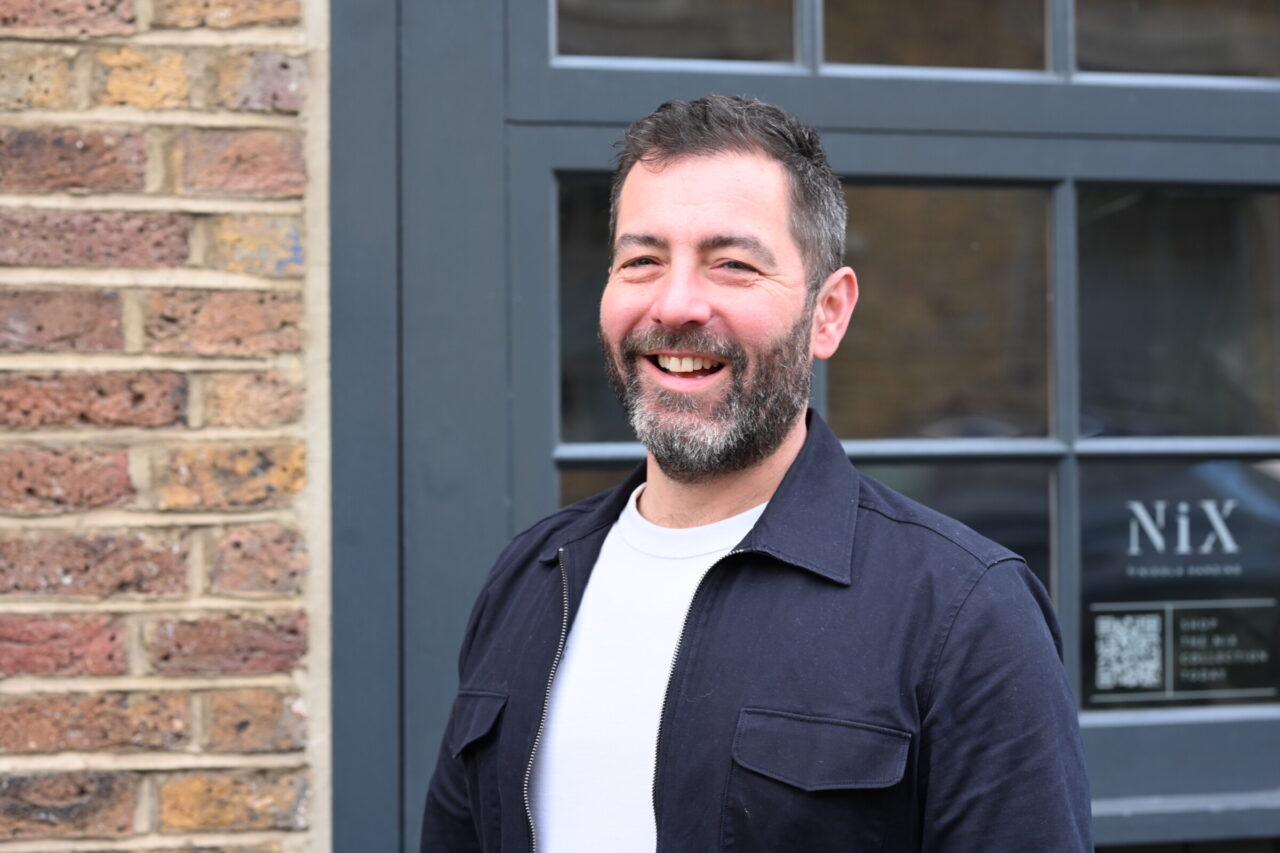
We sat down with our Head of CGI, James Foster, to pick his brains about the CGI landscape, what made him fall in love with visual effects, and the impact AI is having on the industry.
Hi James, thank you for sitting down with me. First of all, tell me about your journey in visual special effects and CGI: what was your first job and how did it bring you to where you are today?
I'm one of those lucky people that decided what they wanted to do and managed to make it work out. As a child I was fascinated by animation and as CG started to appear in the 90s, I knew that was what I wanted to get into. I did art, photography and maths at college, then I studied animation and computer graphics at university.
I started my career as a visualiser working for an agency, and one of their big clients was a medical company called Stryker, based in Switzerland. So, my first job was to do very similar work to what we produce at Point 6 but for medical devices: things like trauma implants, hip replacement products, theatre equipment and scanners. Early on, that gave me a grounding in precise, technical visualisation.
The images were used in operative techniques, which are printed manuals for surgeons. So, I had to get involved in the print side as well, which was good because it gave me the knowledge of how your image on screen actually translates to print, which is of course completely different.
I started to miss the animation side of things, so I moved on to become a motion designer for an agency that did what we call out-of-home advertising: tube escalators, digital billboards, that kind of thing. That taught me a huge amount about motion design, because when your audience dwell time is measured in seconds you need to make an impact. I started doing more and more visual effects work for them and got an offer to do some work for a TV post-production company, working on commercials, firstly as a VFX artist and colourist, then as a technical director, to make sure the shots being filmed were prepared for VFX.
That lead me to become Head of CGI at an agency called PHM working on animations, product replacement and TVCs for Volvo, Ford, and Kia. And finally, here I am at Point 6, leading the assets team and overseeing the production pipeline.
Was there a moment early on in your childhood that made you fall in love with CGI and VFX?
Yeah, I mean, I always loved animation as a kid anyway. That's what I wanted to do. I just used to draw and draw all day long. And, as I said, I'm lucky that I realised quite early that it's not just something I loved doing but something I could do as a job. I think back to something like Jurassic Park. All of a sudden, this film comes out, and there's these incredible new techniques and 3D animation — and there were documentaries about how it's got made on TV at the time. I'm remember watching it and wanting to literally throw my pencil out the window and say, "I'm doing that".
In the context of marketing, how has CGI evolved over your professional career? What's the biggest difference between when you first started and now?
There's a huge difference. One element is the democratisation of technology. And I don't love that word because it often gets misconstrued as 'dumbing stuff down' which in our industry isn't the case.
Free tools like Blender and real-time engines like Unreal are having a huge impact, with major studios starting to move whole pipelines over to them, something that would have been inconceivable only a few years ago. And most platforms now come with tools for hair, fluid, dynamics and physically accurate renders that used to be the reserve of companies big enough to write their own tools.
Then there's just the enormous increase in power that's available. You can do so much more than you used to in the same time frame, and to a much higher fidelity. CG is finding its way into so many more avenues where before it was quite a specialist thing and certainly very expensive. There are probably parallels here with something like video production. What once required hundreds of thousands of pounds of equipment and technicians, you can now do with a laptop and a phone. Similarly, the power that's now available on the desktop in front of me is probably about the same as the whole render farm I used 10 years ago. Smaller, more agile teams can produce photo-real results at a scale that simply wasn't possible previously.
You do need a certain mindset to work in 3D, a certain way of spatial visualisation, and the ability and patience to do a lot of problem solving. And still, even though it's a lot more accessible than it used to be, you need a willingness to learn some pretty obscure and complicated tools. If you look at wider design — certainly the way Adobe has moved all its products towards becoming more accessible, sometimes at the cost of flexibility and features — they are really trying to reach the widest possible audience. Platforms like Canva simplify this even further, but with a tendency to be very templated. Whereas, in my opinion, this is still something that you need a pretty niche skill set for.
On a similar thread then: AI is having a huge impact on pretty much every role within the creative industries. How is it affecting CGI visualisers both positively and negatively?
It's a really difficult thing, because you can sound very resentful when someone with no experience can simply type in a prompt to a website and create images and videos about anything you can imagine. But there's a truth to that. It's getting really scary how good it has become and how quickly that's happening. There's still an element of lack of control, though. No matter how good you are at prompting something, you're not getting the same result over and over again. It's never quite what your mental picture is, but that doesn't mean it's not good.
Certain areas, particularly motion graphics, VFX and that side of the CG world, are impacted quite heavily. But when it comes to product work and the kind of visualisation we do, the issue is you can't give that control to AI because it always tends to change things, even just a bit. For product work that has to be accurate, that's a flat no.
What we're seeing in a very positive sense at the moment is that the professional side of industries like CG, video production, and design have looked at this and recognised that the artist needs to be in control and the product needs to be sacred. There are a lot of tools coming out now — and this is what Point 6 is actively looking at — where AI works as support and assistance. Products from Keyshot and Maxon, for example, let you keep your CAD data completely safe and locked in while using AI to generate backgrounds that match your desired lighting. It essentially becomes like a junior assistant, or a concept artist, giving you a good head start.
This makes it usable, because the big thing for us is: if you're going to risk the product, we can't touch AI. The industry is at a tipping point where it's starting to become possible to protect what matters. For instance, if your product is a watch and you want to place it on a wooden tabletop with a nice evening mood, you do your CAD and 3D work on the actual product. Then you can art direct it — tell the AI you want it sat on a mahogany table with evening light, and it sets that up for you. It moves things around and guesses the look and feel you're after, then you can refine it. That saves a lot of iterative time while keeping you in control.
There's also benefits when it comes to art direction and look development. You can iterate really quickly on how you want something to look. There, it doesn't matter so much about the accuracy you're putting in as input, because you're asking: what's the feeling I want to get out of this? For storyboarding and the early scamping stage where you're establishing the look and feel, you can generate ideas really quickly and get a lookdev that sparks off the idea of how you're going to make it for real. That's another really valuable avenue.
How do you sell that into a client? Because, if you're going to take a really cynical view, it would be: "OK, we're still paying you X amount, but you're saving a lot of time on your end. Where are our savings?". So how does this approach deliver extra value?
Actually, it does deliver value. First off, you need to do standard angles: your product needs to sit on a white background for online, you need a front, a side profile, a three-quarter view, pack shots, and all those kinds of things. That isn't going to change. If those requirements take up all your time, then that's your baseline.
But for your extra carousel images, why not have this baby bottle in a nice kids' playroom environment? Why not iterate some other ideas and create more assets because you've got the time to do it? In that sense, it's a value add.
What you're doing is making the budget go further. You've got to make the standard assets and meet those requirements. But if you can add a few extras without pushing the timeframe or budget any further, then you can really add value.
The perception is that AI just makes everything faster, easier, and therefore cheaper, and it's not true. You either aren't quite in control and you get an approximation of what you want, which is maybe OK for some outputs, but not for product accurate visualisation. Or you're going through so much work to guide the SI that it costs the same anyway.
I think a lot of people are starting to see that. Coca-Cola's Christmas ad was made up of 70,000 AI clips that took 12 weeks to produce — you definitely could have shot a 'real' advert quicker than that, and quite possibly cheaper too.
You joined Point 6 last year to head-up our CGI department. What are your goals and expectations for the next 12-months? If we sat down again in December, what would a successful year look like for you?
Well, if we're sitting down in December, it means I'm still here, so that would be a personal success! But no, in all seriousness, the boring and slightly obvious answer would be that we want to carry on nailing the campaigns we work on and keep on bringing value to projects using the tools and methods we've been discussing. Our department is still relatively new, and we want to increase the awareness of our CGI capabilities with our existing clients whilst also bringing in new clients based on the merits of our work. We want to keep pushing the envelope and approaching things in fresh and interesting ways.
On a more personal note, I really want to keep driving the guys to develop their skills and get even better than they already are at executing the techniques we work on every day. It's cliché, but the success of Point 6 is really in its people, and we're lucky to have a really smart, hardworking group of guys. The ideas we're discussing are really exciting and we look forward to sharing more and more of that work as the year goes on.
More generally, what excites you about the possibilities of CGI? What do you imagine the industry will look like in five years' time?
It's undeniably going to be a very different place in five years. There are a lot of legacy tools and legacy ways of working that aren't long for this world. Yes, AI is part of it, but it's also the way clients are approaching CG now; a very CG aware mentality and how they're professionalising their own pipelines.
One of the big things that's going to make the biggest positive impact — outside of AI as an assistant and things like that — will be real-time CG breaking through as a standard, so that we're no longer thinking about a rendering process and we're just able to visualise more or less in real time. That's not a new thing, but I think it's not standard yet either. It's close. It's going to be transformational when we can accurately put on screen what we want to visualise at that kind of speed. It's going to open up so many doors and make a huge difference.
The way technology has moved in the last 20 years, you're not waiting 24 hours to see a single frame of CG now. You're talking seconds or minutes. When it becomes something you can see more or less in real time, accurately, then you can dedicate all your time to the visual itself, not to optimising and thinking about pipeline processes. You can work so much more quickly when you can just see exactly what you're doing, which, ironically, will be more like the old days of photoshoots.
We're getting to the point where real-time engines are getting close to what you expect from a deferred engine — the kind we use, like V-Ray or Redshift, where it takes time to process and generate the final frame. When they reach that same level of fidelity, where you really can't tell the difference between a deferred and a real-time engine, it's going to completely transform what we do. You'll get your object, set up a camera, light it, and say, " this is great, this is what I want" and move onto the next shot.
Thanks James, really appreciate your time.
No worries, mate!